

Mobile patrols suit vacant sites and multi-site cover, while a static guard suits continuous control at one busy location. Patrols visit on a schedule, check logged patrol points, respond to alarms, and lock up. A static guard stays on post, controls who comes in, and watches one site without a gap. If your site is empty at night, patrols are usually enough. If people come and go all day, a static guard is usually the better fit. Many sites use both.
The short answer
Mobile patrols suit vacant sites and multi-site cover, while a static guard suits continuous control at one busy location. Patrols visit on a schedule, check logged patrol points, respond to alarms, and lock up. A static guard stays on post, controls who comes in, and watches one site without a gap. If your site is empty at night, patrols are usually enough. If people come and go all day, a static guard is usually the better fit. Many sites use both.
This is one of the most common questions site managers ask. The two services solve different problems, and picking the wrong one leaves a gap. A vacant warehouse with a guard on the gate all night is paying for cover it does not need. A busy distribution centre with only a patrol visit every few hours is leaving long stretches unwatched.
What a static guard does
A static guard stays at one post for the whole shift. The post might be a gatehouse, a reception desk, a warehouse entrance, or a control point inside a building. The guard’s job is continuous: watch the entrance, check who comes in, sign visitors in and out, check vehicles, and keep an eye on the site from a fixed position.
The strength of a static guard is presence. There is always someone there. A delivery driver always finds a person at the gate. A contractor always signs in. A visitor who should not be there is stopped at the door, not discovered later on the floor. For sites with steady traffic, that continuous control is hard to replace.
What mobile patrols do
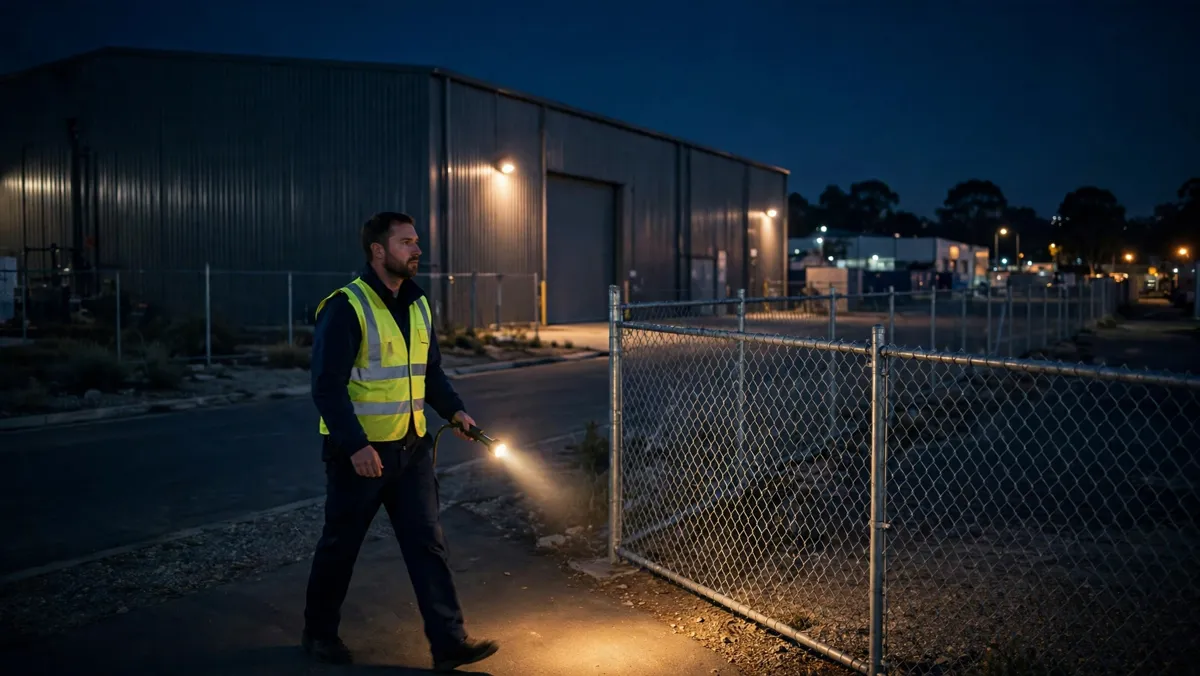
Mobile patrols work differently. A patrol officer drives a set route across one or more sites, stopping at each one to check it. The officer walks the site, checks doors and gates, checks the perimeter, looks for damage or intruders, and logs each stop.
Patrols are built around scheduled stops at logged patrol points: the front gate, the rear roller door, the plant room, the storeroom, the car park. Each stop is recorded with the time and what was found.
Two parts of patrol work deserve their own mention. The first is randomised patrols. A patrol that arrives at the same time every night can be watched and avoided. Patrols that vary their timing and their route make a site harder to target. The second is alarm response. When an alarm sounds, a patrol officer goes to the site, checks it, and reports back. The officer does not walk into danger: if there are signs of a break-in, the officer secures what can be secured from outside, calls police, and hands over.
Lock-up is the third patrol job that clients value. At the end of the day, the patrol officer walks the site, checks that doors and windows are locked, that equipment is off, and that nobody is left inside, then secures the gates. For a site that closes at six and opens at seven, a lock-up visit plus overnight patrols covers the whole dark period.

The patrol vs static rule
The rule is simple. Patrols suit vacant sites and multi-site cover. Static guards suit continuous control.
A vacant site has no people to manage. What it needs is regular checking: someone to walk it, test the doors, look at the fence, and confirm it is still secure. A patrol does that well, and one patrol officer can cover several vacant sites in a night. A static guard on an empty site is paying for a person to watch a place where nothing is happening.
A busy site is the opposite. People arrive, deliveries come in, contractors need signing in, and visitors need directions. That work needs a person on post, all shift. A patrol that visits for twenty minutes every few hours cannot control a gate. It can only check it.
Comparing the two side by side
| Question | Static guard | Mobile patrols |
|---|---|---|
| Best for | One busy site with steady traffic | Vacant sites, after-hours cover, several sites at once |
| Presence | Continuous, one post | Visits on a schedule, several stops per visit |
| Access control | Signs in every visitor, checks every vehicle | Checks gates and doors at each stop |
| Alarm response | On site already | Travels to site when an alarm sounds |
| Lock-up | Can secure the site at shift end | Lock-up visit is a standard patrol task |
| Reporting | Shift report plus incident reports | Patrol log plus incident reports |
The table is a guide, not a verdict. The right answer depends on the site: its size, its hours, what is stored there, and what has happened there before.
When a static guard is the better choice
Choose a static guard when the site has people to manage. A construction site in its busy phase, a distribution centre with trucks all day, a warehouse with contractors coming and going, an office building with visitors — these sites need someone at the gate, all shift.
Choose a static guard when the site needs control, not just checking. If unauthorised entry is a real risk, a guard at the door stops it at the door. If deliveries need checking, a guard checks every one. If the site has a sign-in obligation for safety, a guard runs the sign-in.
When mobile patrols are the better choice
Choose mobile patrols when the site is empty after hours. A vacant warehouse, a closed yard, a site between tenants, a building awaiting fit-out — these sites need checking, not staffing. Patrols give you that checking at a sensible level of cover.
Choose patrols when you have several sites to cover. One patrol officer can check a depot, a yard and a vacant shop in one run. Staffing a guard at each one would be a different proposition entirely.
Choose patrols when the risk is occasional, not constant. If the site has had a break-in or a spate of vandalism, patrols break the pattern. Randomised timing means nobody can plan around the visit. A few weeks of visible patrols often settles a site down.
When to combine both
The strongest setup for many sites is a static guard by day and patrols by night. The guard runs the gate while the site is busy. The patrol checks the site after lock-up, responds to alarms, and hands the site back in the morning.
Questions to ask before you choose
- Site hours — when is the site occupied, and when is it empty?
- Traffic — how many people, vehicles and deliveries use the gate each day?
- Risk — what has happened here before: break-ins, vandalism, unauthorised entry, or nothing yet?
- Response — who attends when the alarm sounds, and how fast?
- Logging — what does the patrol log show, and how quickly do you see it?
- Flexibility — can the mix change as the site changes, without a new contract each time?
How JM Security Group can help
JM Security Group provides security mobile patrols and static guards in Melbourne: randomised patrols, alarm response, lock-up visits, and staffed posts that fit the site. If you are not sure which suits your site, describe the hours, the traffic, and what is stored there, and ask for a plan that matches the cover to the risk. See Security Mobile Patrols for patrol detail, Security Guard Services for staffed posts, and All Services for the full list. To start, use the quote form, call 03 9716 1160, or email operations@jmsecuritygroup.com.au. Standard bookings are scheduled within 48 hours of confirming the contract, and for emergency call-outs the aim is to respond within 2 hours. JM Security Group operates under Victorian security licence VIC Z70-400-80S.
FAQ
Q: When are mobile patrols better than a static guard?
A: When the site is empty after hours, when you have several sites to cover, or when the risk is occasional rather than constant. Patrols check vacant sites, respond to alarms and lock up.
Q: When does a site need a static guard instead?
A: When the site has steady traffic: people to sign in, vehicles to check, deliveries to receive, and visitors to direct. A static guard gives continuous control at the gate, all shift.
Q: Can I use patrols and a static guard together?
A: Yes, and many sites do. A static guard runs the gate while the site is busy, and patrols take over after lock-up, respond to alarms overnight, and hand the site back in the morning with a written log.
Q: What does a patrol log show?
A: Each stop with the time, the patrol point visited, and what was found — doors and gates checked, damage noted, incidents recorded. The log is your proof of coverage and goes to you in the shift report.