
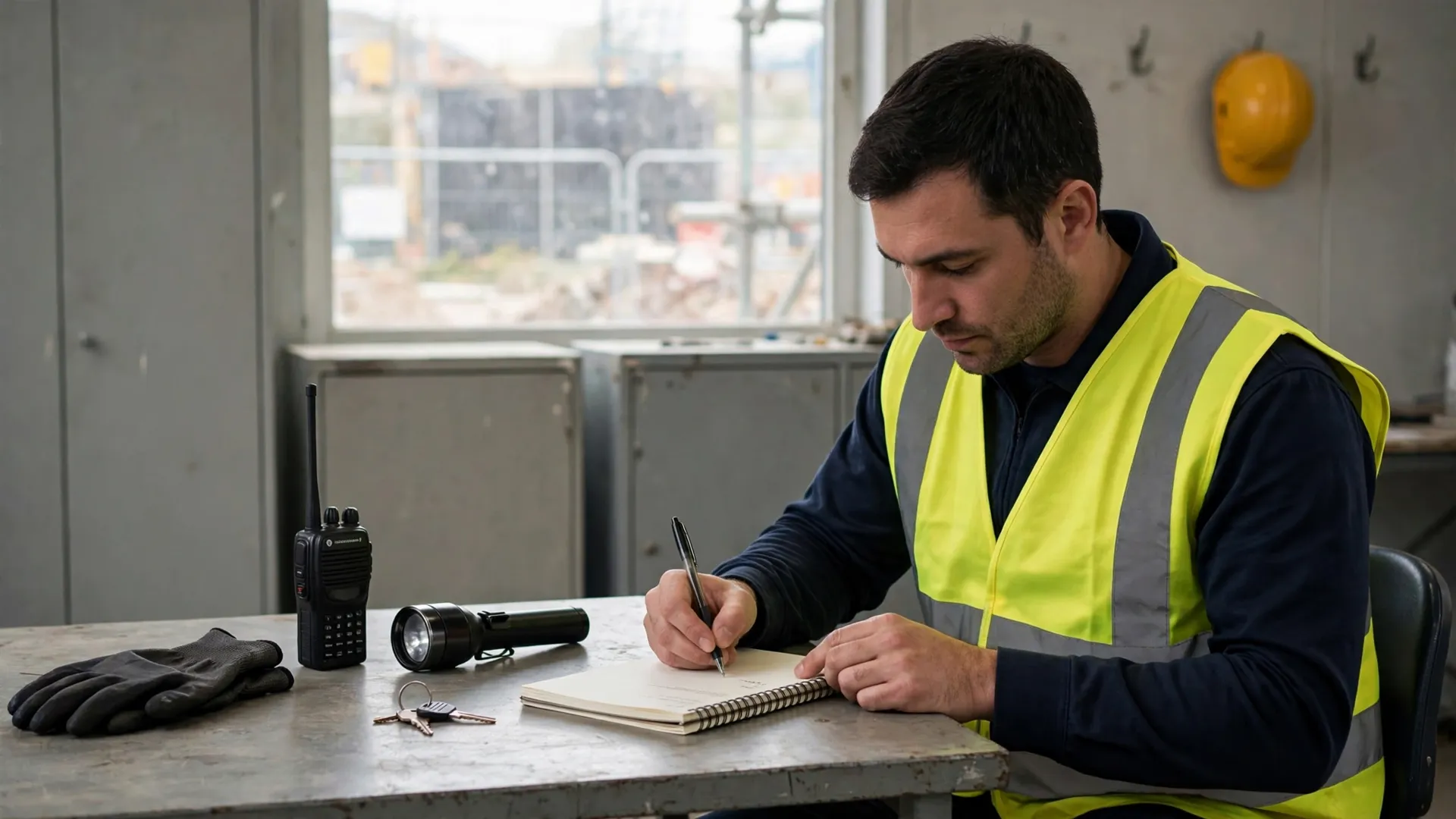
A security incident report should include time plus location plus people plus actions plus evidence plus supervisor follow-up. It should record when the incident happened, where it happened, who was involved, what the guard saw and did, what evidence was collected, and what the supervisor did next. A report that covers those six areas is useful. A report that misses one of them leaves questions that nobody can answer later.
The short answer
A security incident report should include time plus location plus people plus actions plus evidence plus supervisor follow-up. It should record when the incident happened, where it happened, who was involved, what the guard saw and did, what evidence was collected, and what the supervisor did next. A report that covers those six areas is useful. A report that misses one of them leaves questions that nobody can answer later.
Reports are the part of security that outlasts the shift. Guards go home. The report stays. It is what the site manager reads in the morning, what the insurer asks for after a claim, and what police ask for when they follow up.
Why incident reports matter
Incident reports matter for three practical reasons. First, they drive action. A report that says a fence panel was cut at a certain time in a certain place tells the site team exactly what to fix. A report that says “fence damaged” tells them almost nothing.
Second, they support follow-up. If police attend, if an insurer asks questions, if a dispute arises about what happened, the report is the record. Memory fades. Notes written at the time do not.
Third, they reveal patterns. One incident is an event. Three incidents at the same gate, on the same nights, at the same hours, are a pattern. Pattern-spotting only works when reports are consistent: same fields, same detail, every time.
The reporting standard: six parts
1. Time
Every incident report starts with time. When did the incident happen, and when was it discovered? Record the time the guard first noticed something, the time of any key events, and the time the report was written. If the exact time is not known, say so.
Times should be consistent across the report. If the shift report says the patrol passed at 02:30 and the incident report says the damage was found at 02:40, the two should agree.
2. Location
Location should be specific enough that someone who has never visited the site can find it. “North-west corner, near the materials compound, bay 4” is useful. “On site” is not. Use the site’s own names for areas, gates and buildings, and add a landmark where it helps.
If the incident moved – for example, a person walked from the front gate to the compound – record the route. Where they entered, where they went, where they left.
3. People
Record who was involved: the guard or guards who attended, any witnesses, and any other people involved. For members of the public, record observable descriptions: what they were wearing, approximate height and build, any distinguishing features.
Do not record guesses about people. Do not write down motives, intentions or character judgments. “The person climbed the fence and ran toward the road” is a fact. “The person was clearly planning to steal tools” is a guess.
4. Actions
Actions are what the guard did and what others did, in order. Observed the person at the fence. Called the supervisor. Contacted police. Kept watch from a safe distance. Secured the gate after the person left.
Actions also include what the guard did not do, where that matters. If the guard stayed at a safe distance rather than approaching, the report should say so and why.
5. Evidence
Evidence is everything that supports the report: the guard’s notes, photographs of the scene, CCTV footage references, the patrol log, the sign-in log, and any items found. Photographs should show the scene as found, with a note of the time taken and what they show.
Evidence handling should be simple and clean. Do not move items unless there is a safety reason. Do not touch anything that may be needed by police. Note who took custody of any item, and when.
6. Supervisor follow-up
The report is not finished when the guard finishes writing. The supervisor reviews it, checks it for completeness, and signs it off. The supervisor decides what happens next: repairs ordered, police contacted, client notified, post orders updated, extra cover arranged.
What to write, and what to leave out
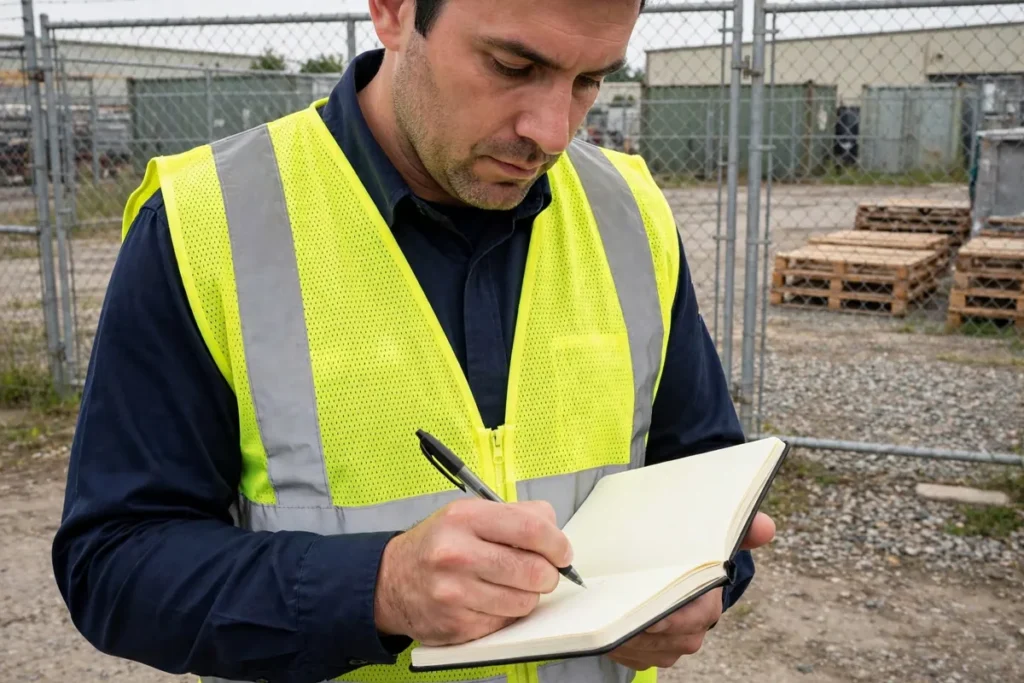
Good reports stick to facts. Write what was seen, heard and done, in the order it happened. Use plain language and short sentences. The reader may be a site manager, an insurer, or a police officer. All of them should be able to read the report once and understand it.
Leave out opinions, guesses and blame. Do not write that someone “looked suspicious” without saying what they did. Do not write that a contractor “obviously” did something. If the guard did not see it, the report should say who reported it and what they said.
Leave out anything that is not relevant. A report about a broken fence does not need the guard’s views on the site’s management. Relevance keeps reports short, clear and usable.
Shift reports and incident reports
Not every report is an incident report. A shift report is the routine record of a shift: checks done, patrols completed, visitors signed in, deliveries received, defects found, and anything handed over. An incident report is written when something specific happens: a break-in, damage, an injury, a dispute, a trespass, a fire alarm, or anything that needs follow-up.
A security guard incident report should be written on the same shift, before the guard goes home. Memory is freshest in the first hour. A report written the next day loses detail.
A security reporting template you can use
A simple template keeps reports consistent. Every incident report should include:
- Incident reference – a unique number for the report.
- Date and time – when it happened, when it was discovered, when the report was written.
- Location – specific area, with landmarks.
- People – guard, witnesses, others involved, with observable descriptions.
- What happened – the sequence of events, in order, in plain language.
- Actions taken – what the guard did, with times.
- Evidence – notes, photographs, CCTV references, items found, chain of custody.
- Authorities contacted – police or ambulance, with times and reference numbers where given.
- Supervisor follow-up – review, sign-off, and actions taken, with dates and names.
Ask your provider to show you a sample incident report before you engage them. A provider with a clean template and a clear follow-up process will show it gladly. A provider that cannot show you one is telling you something.

How the report helps the client
A good report helps the client in concrete ways. It gives the site manager a clear picture of what happened overnight, so the morning starts with action instead of questions. It supports insurance claims with dated, detailed records. It supports police follow-up with a clean account.
It also helps the client improve the site. A pattern in the reports – the same gate, the same nights, the same type of incident – tells the client where to spend money: better lighting, a repaired fence, a changed patrol route, a new access rule.
How JM Security Group can help
JM Security Group provides security guard services in Melbourne with written reporting on every shift: shift reports for routine cover, and incident reports that record time, location, people, actions, evidence and supervisor follow-up. If your site needs guards who document what they do, describe the site, the hours and the reporting you need, and ask for a plan built around your post orders and your reporting format. See Security Guard Services for the service detail, Security Mobile Patrols for patrol-only cover, Loss Prevention for stock and asset protection, and All Services for the full list. To start, use the quote form, call 03 9716 1160, or email operations@jmsecuritygroup.com.au. Standard bookings are scheduled within 48 hours of confirming the contract, and for emergency call-outs the aim is to respond within 2 hours. JM Security Group operates under Victorian security licence VIC Z70-400-80S.
FAQ
What should a security incident report include?
Time plus location plus people plus actions plus evidence plus supervisor follow-up. It should record when and where the incident happened, who was involved, what the guard saw and did, what evidence was collected, and what the supervisor did next.
How soon should an incident report be written?
On the same shift, before the guard goes home. Memory is freshest in the first hour, and a report written a week later from memory is unreliable.
What is the difference between a shift report and an incident report?
A shift report is the routine record of a shift: checks, patrols, visitors, deliveries and handover. An incident report is written when something specific happens that needs follow-up.
Should a security incident report include opinions or guesses?
No. It should stick to facts: what was seen, heard and done, in order. Opinions, motives and blame do not belong in a report, and they make the report less reliable.