
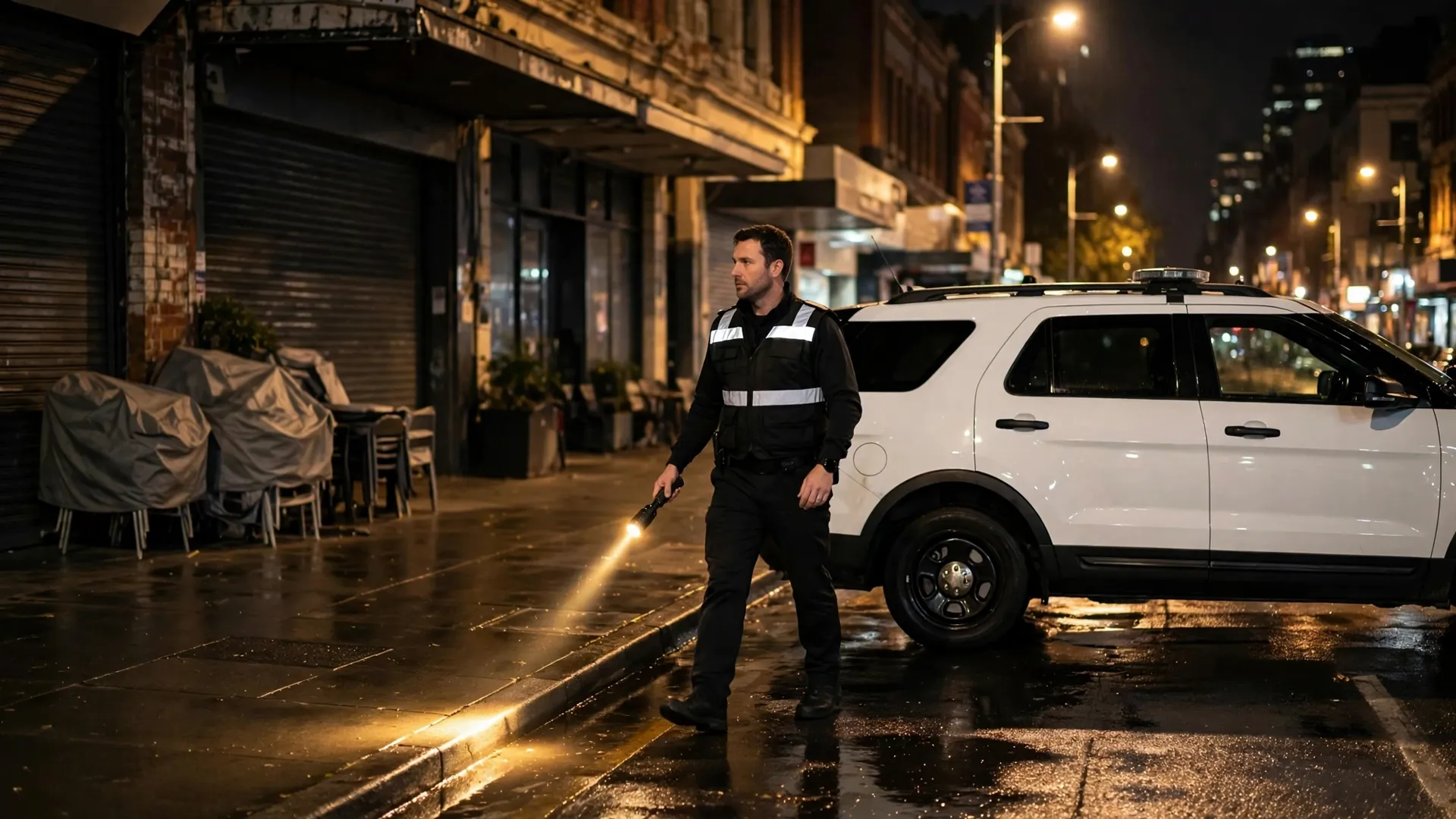
What happens during a mobile patrol visit at night? The patrol officer arrives, checks the perimeter, tests doors and windows, walks the scheduled stops, carries out agreed lock-up duties, and leaves a written report. The visit is logged with times and observations. A night patrol is not a drive-past — it is a physical check of the property, done on foot, by a licence-holding officer, with a record left behind.
The short answer
What happens during a mobile patrol visit at night? The patrol officer arrives, checks the perimeter, tests doors and windows, walks the scheduled stops, carries out agreed lock-up duties, and leaves a written report. The visit is logged with times and observations. A night patrol is not a drive-past — it is a physical check of the property, done on foot, by a licence-holding officer, with a record left behind.
This post walks you through a typical visit: steps vary by site, but the sequence — arrive, check, lock up, report — stays the same.
What a mobile patrol is
A mobile patrol is a security service where an officer in a patrol vehicle visits your property at agreed times, usually at night when the site is empty. It suits businesses that want their premises checked without a guard on site all night: offices, warehouses, retail shops, schools, depots, showrooms and construction sites.
The key idea is presence without permanence: a static guard stays in one place, while a mobile patrol covers several sites in a night. Visits are randomised where the arrangement allows, so the timing is not predictable — a site checked at a different time each night is harder to target.
Patrols are often combined with other duties: lock-up at close of business, alarm response, a check after a storm, or key holding for out-of-hours access. When you set up a patrol service, you agree the scope — which sites, which nights, which duties, and what the officer should do if something is wrong.
Before the visit: the patrol plan
Every site on a patrol run has a plan listing the address, access arrangements, areas to check, scheduled stops, lock-up duties, escalation steps if the officer finds a problem, and emergency contacts: who to call if a door is open, an alarm is sounding or there is damage.
The plan makes a patrol repeatable: every visit follows the same sequence, and the report shows what was done. Expect the provider to ask for a site walk-through or a detailed brief — it catches the side gate nobody mentioned, the roller door that does not sit properly, and the plant room that needs a check. Key handover is part of the plan too: which keys, who issued them, where they are stored, and how they are returned.
The visit, step by step
1. Arrival and perimeter check
The officer starts with the perimeter: a walk or drive around the boundary, looking for forced entry, damaged fencing, open gates, broken windows and anyone who should not be there.
The perimeter check is where most problems are found: a cut fence, a gate left ajar by the last contractor out, a window forced during the day. A night patrol catches these early, before the next night makes them worse.
2. Doors, windows and access points
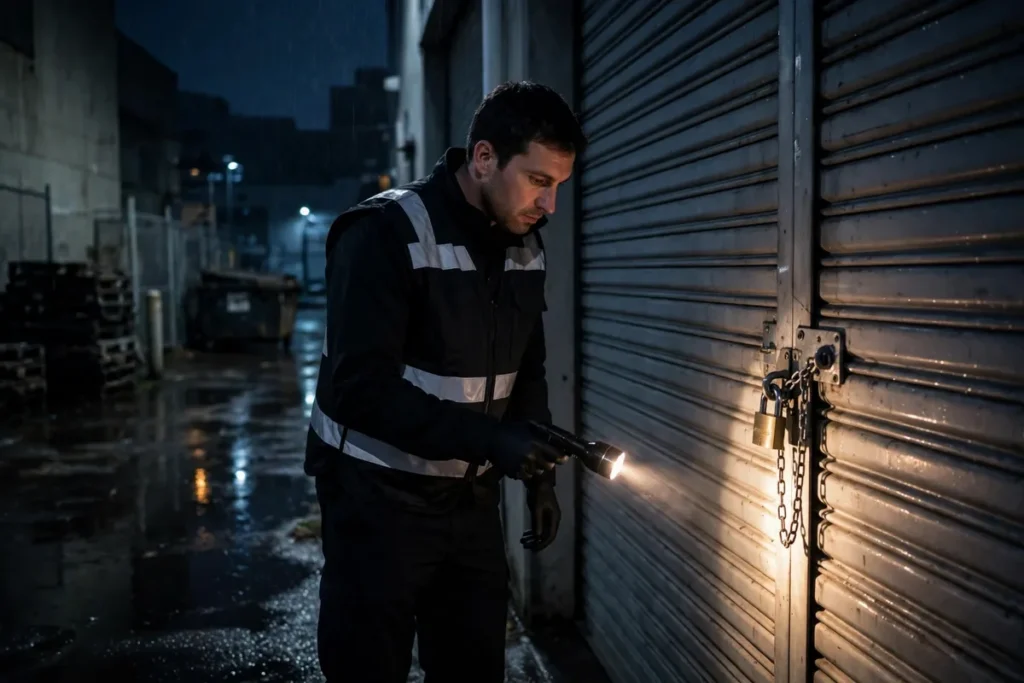
Next, the officer tests doors and windows: every external door confirmed locked, roller doors and shutters seated and secured, ground-level windows checked. Any door found open is investigated — signs of entry checked, interior checked from a safe position, escalation plan followed if anything is out of order.
This is also when the officer checks the small things: a fire exit propped open, a delivery door left unlatched, a padlock not seated. The officer secures what can be secured and records what needs the site owner’s attention.
3. Scheduled stops and logged patrol points
The officer then walks the scheduled stops — the points the patrol plan names, recorded at each visit so the report shows the route covered. A typical set includes the front entry, rear yard, plant room, loading dock, car park and any area holding valuable stock.
At each stop, the officer looks for that spot’s specific risks: water leaks near plant, equipment left running, rubbish near a fire exit, vehicles parked where they should not be, or signs of someone having been there. Naming the stops in advance means nothing gets skipped.
4. Lock-up duties
If lock-up is part of the arrangement, the officer carries it out as agreed: setting the alarm, closing and locking gates and roller doors, switching off lights or equipment, and confirming the site is secure before leaving. For some businesses, the patrol officer is the person who locks up, so the last staff member does not stay back alone.
Lock-up duties are agreed in writing before the first visit: what gets locked, what gets switched off, and what to do if something will not lock or an alarm will not set. If the alarm will not set, the officer follows the escalation plan — contact the site owner or the alarm company, stay on site if the plan requires it, and record the fault.
5. Alarm response
Some patrol arrangements include alarm response. If your alarm activates during the night, the patrol officer attends, checks the site from outside first, then inspects as the plan requires — looking for signs of entry, checking whether the trigger was a fault, an animal, weather or a genuine break-in, and following the escalation steps.
Alarm response is one of the most valuable parts of a patrol service: an alarm that brings an officer to the site gets it checked, secured and reported on before morning.
What the report tells you
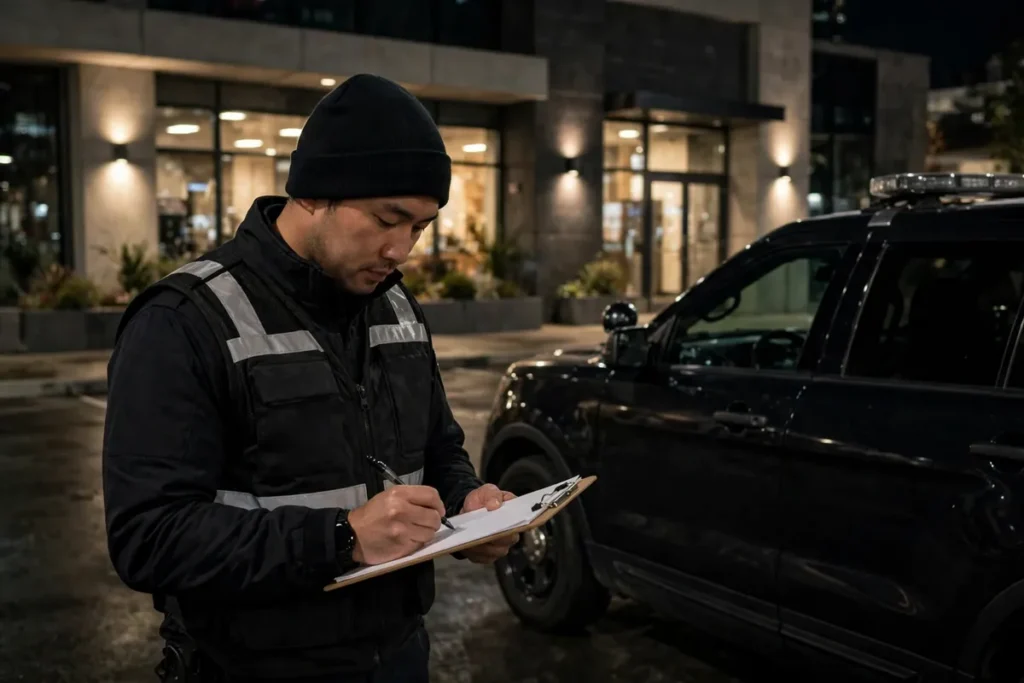
Every visit ends with a report recording the date and time, the officer who attended, the stops covered, what was found, what was done, and anything needing the site owner’s attention. If nothing was found, the report says so — “all secure” is the record that the site was checked and found secure.
Ask to see a sample patrol report before you engage a provider — look for specific observations, not vague lines. “Rear roller door found unlatched, secured at 11:42 pm, site owner notified” tells you the service is working. Keep the reports — they build a picture of your site over time: the gate that keeps being left open, the fence section that keeps failing, the night the alarm faulted twice.
What happens if something is wrong
When something is wrong, the officer follows the plan: secure what can be secured, preserve the scene where there may have been a break-in, contact the site owner and alarm company, and call emergency services where needed. The officer observes, records and reports, and that record — times, observations, photos where the arrangement allows — supports your insurance claim and any police report.
If a door will not lock or a window is broken, the plan should say what happens: stay on site until a contact arrives, arrange a temporary secure, or increase visit frequency for the following nights. Agree these steps before the first visit, not during an incident at 2 am.
What to ask before you book a patrol service
Before you engage a provider, confirm:
- Visits — how many visits per night, and whether timing is randomised.
- Stops — which scheduled stops and logged patrol points are covered on each visit.
- Duties — lock-up, alarm response, key holding, and what each includes.
- Reporting — report format, how quickly you receive it, and a sample report.
- Escalation — who is called, in what order, when something is wrong.
- Licence — the provider’s Victorian security licence, and that officers hold one.
How JM Security Group can help
JM Security Group provides Security Mobile Patrols in Melbourne: night patrols, randomised visits, lock-up, alarm response and written reports your team can act on. Describe the property, the hours and the duties you need, and ask for a patrol plan built around your scheduled stops and escalation steps. See Security Mobile Patrols for the service detail, Security Guard Services for static cover, and All Services for the full list of 12 services. To start, use the quote form, call 03 9716 1160, or email operations@jmsecuritygroup.com.au. Standard bookings are scheduled within 48 hours of confirming the contract, and for emergency call-outs the aim is to respond within 2 hours. JM Security Group operates under Victorian security licence VIC Z70-400-80S.
FAQ
What happens during a mobile patrol visit at night?
The officer checks the perimeter, tests doors and windows, walks the scheduled stops, carries out agreed lock-up duties, and leaves a written report, logged with times and observations.
Are mobile patrol visit times randomised?
Where the arrangement allows, yes. Randomised timing means the visit is not predictable, making the site harder to target.
Does a mobile patrol include alarm response?
It can. If alarm response is part of your arrangement, the officer attends on activation, checks the site, follows the escalation plan and reports what was found.
What should a patrol report include?
Date and time, the officer who attended, the stops covered, what was found, what was done, and anything needing the site owner’s attention — with specific observations, not vague lines.